
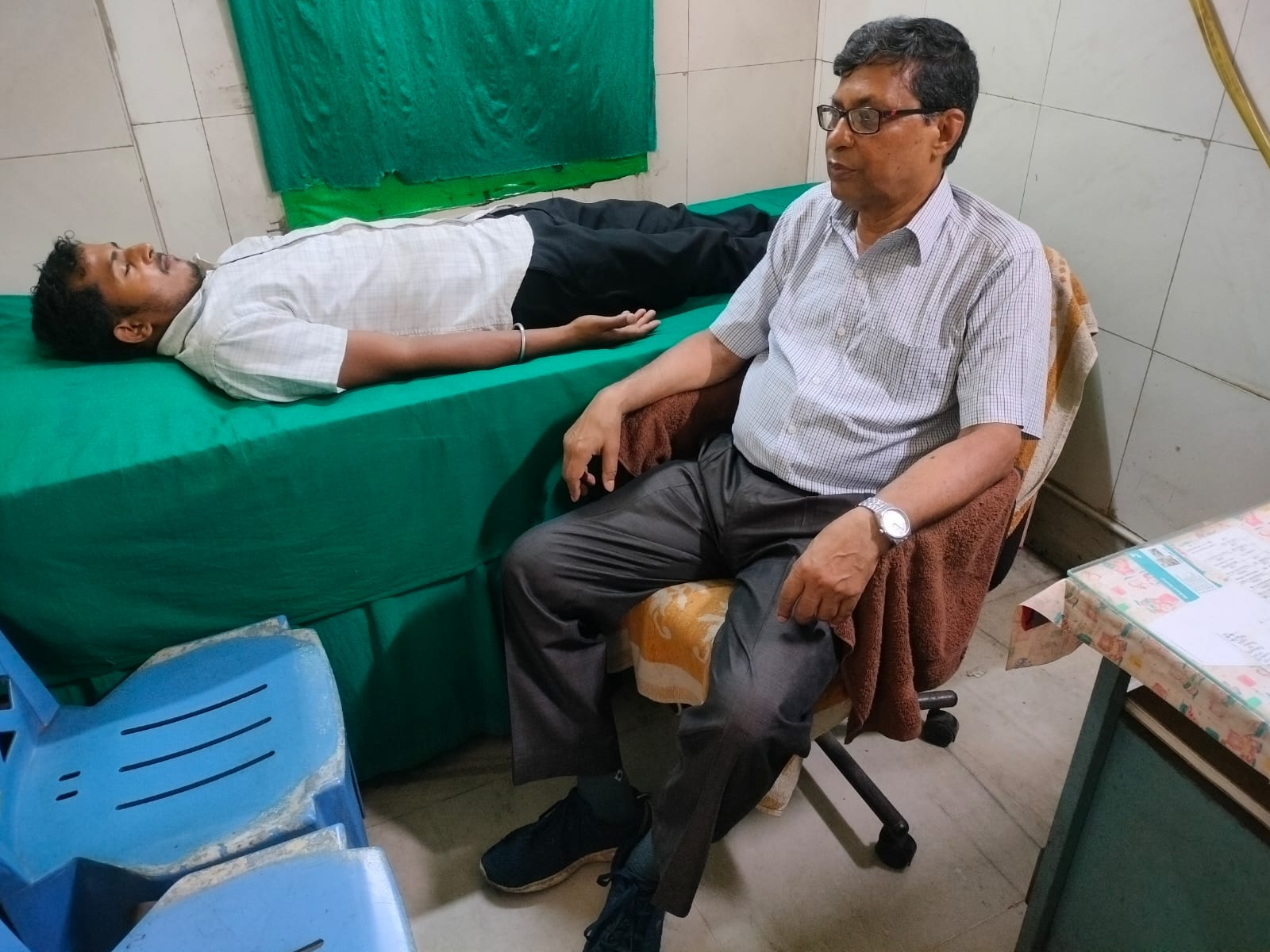
Dhirendranath discussed and did his research on Pavlov all his life and he may easily be called a pioneer in this field in the whole of Asia. He introduced the talent of Pavlov as a scientist in our country otherwise the latter would have been known to only a few people confined in the text books only. He was the first to reveal the scientific genius of Pavlov and his influence on our daily life and thought and that alone accounts how a discussion on Pavlov and Dhirendranath is one and the same.
It has to be necessarily remembered that Pavlov was born in Tzaristic Russia, although he was a Jew, and worked for 19 years in Post-revolution Russia. On the other hand Dhirendranath was nurtured in British India for 36 years. He started his research work on Pavlov in post-independent India. There certainly was a difference between Pavlov’s Russia and Dhirendranath’s Bengali society on social-economic ground. The uproar that took place due to Tzar Alexander’s work on reformations in Russia could be compared to the changes in thought-current in so called Bengal Renaissance which affected every field of thought but access to European development in the medical science was not so easily available to Dhirendranath as it was to Pavlov.
As such the opportunities that Pavlov enjoyed on his way to become a scientist was not available to Dhirendranath. Also there remained a long tradition of research in the field of physiology in Russia. That helped Pavlov to adopt research on physiology as the goal of life more easily which was denied to Dhirendranath due to such meagre facilities in India. There also was a lack of such researchers in India who continued any work of research unabated on any subject, specially medicine.
Further the science of psychology was by then coming out of philosophy and was almost being born as a separate and independent branch of medical science. In such an uncertain field of career Dhirendranath opted for research and profession in the arena of psychology and he could see none who had done so in order that he could get an inspiration as a model.
On the other hand Pavlov could draw his inspiration from scientists like Sechenov, Tsion and such other physiologists who were both powerful and worthy to be followed as ideal teachers. There was also a difference in the brain-type of Pavlov and Dhirendranath.
It was in 1936 that Dhirendranath came to know Pavlov suddenly in Australia through Dr. Bethune. Prior to this he had heard about Pavlov like other students but was yet to understand the importance of his work. He came to know of it from the works of Pavlov that Dr. Bethune left behind on his way to Russia to attend the funeral of the former.
Incidentally Dhirendranath stayed in the same house where Dr. Bethune stayed when he had gone to Australia to learn the process of manufacture of powdered milk. There he read the works of Pavlov and came to know the importance of research on neurophysiology which was to change the course of his desired career in life.
Next came a period of conflict. Inspired by Acharya Prafulla Roy’s ideal to make India self-sufficient in the field of industrial business, Dhirendranath had thought of the manufacture of powdered milk and he was the only holder of such a certificate in that field in India.
He graduated from Calcutta Medical College in 1931 and went for relief work in earthquake-stricken Bihar and he had no ambition to be a practising physician at that time.
On his return from Bihar he, therefore, concentrated on the business of manufacture of powdered milk following the call of Acharya Prafulla Chandra Roy to make the country self-reliant through the spread of Industrial Business.
He went to Australia to learn the trade of his choice but within a few years he realised that to pursue the same was not at all smooth and easy. Within a short period he faced a great crisis in the business of his choice and settled in his Bhowanipur residence closing the trade that he very idealistically started.
In such a tight corner as above, Dhirendranath had the only option to start a profession as a medical practitioner and that he did, being a practising psychiatrist privately. The time was 1945-46 and Dhirendranath was about 35 years of age.
Initially he started his medical practice in the rented house of Bhowanipur and later in the rented house at Shyambazar permanently.
Here it needs be remembered that Dhirendranath faced extreme poverty during his student days and it was then that he came in touch with active left politics which made it easier for him to be a social scientist rather than a psychiatrist.
That was also a time when psychiatry did not develop in our country as of today and that accounts for his work in that field as a pioneer scientist.
He was extremely successful as a practising psychiatrist in the later stage of his life and if his original contribution in hypnotic suggestion-therapy could be recorded properly then he would have been known as a front-line psychiatrist of the world but that was not possible to be done and, therefore, it is not a place to discuss the same.
On his return from Australia he contacted the Russian Embassy to get hold of Pavlov’s research works and pursue his studies in that direction. After this he was engaged in the business production of powdered milk for 12-14 years but was unsuccessful in doing so.
That made him rent a house around 1947-48 in Bhowanipur and start practice as a physician. There were many choices in his mind at that time but there was an interim period when he was not associated with practising medicine.
At that time he was urged to do something with his social consciousness which was developed with the integration of Pavlovian second signalling system and Marxian dialectical materialism and that prompted him in his choice to practise psychiatry.
That apart he nurtured some boyhood hobbies like football and drama. He wrote many plays and organised a play-group to stage those plays. We may now call those plays as India’s first qualitatively composed psychodramas.
He also decided to bring out a Bengali journal dedicated to the emancipation of the working class through the individual emancipation of people in the perspective of Marxian social science, social workers and the front runners of the party, educated in the modern trend.
So in 1961 under his editorship was published quarterly Manabmon. It must be mentioned that the name Manabmon came from Dhirendranath’s young poet friend Arunachal Bose.
From the above it is not difficult to understand that due mainly to social obligations Dhirendranath was not able to concentrate either in physiology or in psychiatry and so he spread his life’s activities in many diverse directions.
Hence he was not able to get for himself any strict disciplined academic studies and research as Pavlov did. We could expect that from him had he gone to any Western country to pursue his research and psychiatry practice remaining attached to any Institution in India.
That helped many lesser people to earn greater honour and recognition in the field of psychiatry than him. Due to such negligence he immersed himself fully in the socio-political thoughts in many diverse directions and started flowering in such a field day by day.
In midst of all such activities enumerated above, he organised many seminars, discussions and himself participated in those. That undoubtedly spread the name and scientific works of Pavlov on Indian soil.
This indeed is a mentionable fact in our social history and he participated in discussions wherever those were held and he was invited to participate.
The only problem remained in that the American Psychiatry Association did not support Pavlov’s hypnotic suggestion therapy and so the latter was not accorded the importance he deserved in India.
Pavlov’s scientific discoveries, therefore, faced ridicule which was uncalled for. Dhirendranath, in spite of his powerful influence and abilities, was not serious enough to establish the great scientific mind of Pavlov to psychiatrists of India to counter the ridicules that they hurled at Pavlov’s thoughts unnecessarily.